Life’s Sending You a Message, Are You Listening?

cough drops

I have an addiction to Halls cherry cough drops. I love the taste of them, slightly medicinal with an underlying sweetness, and the size, one drop lasts about five minutes.  They’re portable, don’t have an expiration date, and the wax-paper like wrapping protects them from the abuse of being carried in pockets, purses, and the car console.

A few years ago I was attending yet another boring work meeting in a job that consisted of going to boring meetings. We were seated around a conference table so there was no way to secretly work on a grocery list or write hate mail. Opening up my laptop and checking my email was out, too. Looking at the small, crumpled pile of cough drop wrappers in front of me, I realized they had printing on them. I unwrinkled one and was surprised to find it covered with messages such as “Dust off and get up,” “You’re resilient,” “You’ve survived tougher,” and an explanation in all caps,  “A PEP TALK IN EVERY DROP.”

You tell 'em, little Halls cough drop wrapper

You tell ’em, little Halls cough drop wrapper (Photo credit: spiffie)

Five years of addiction to these delicious cough drops and now I find out there’s a pep talk in every drop? How could I have been so blind? Still, the messages started me on a path that included enrolling at Goddard College, inching my way out of the nursing profession, and starting this blog. All because of messages I had been carrying around for years, but had been too busy and preoccupied to see.

It’s like when you buy a red car and you start to see red cars everywhere, when you’re ready, you see that signs are everywhere.  Unhappy with your job? A college catalog with a certificate course you’ve always wanted to take ends up on your kitchen table. Stressed out over finances? You see a small notice on the bulletin board at your gym offering free membership in exchange for volunteer work. House falling apart? A little blurb in the newspaper asks for volunteers to learn about home repair through helping low-income homeowners.

Crazy "do not" signs

Crazy “do not” signs (Photo credit: remysharp)

It isn’t that the catalog, notice or blurb decided to show up that day to entice you. It’s been there a while, waiting for you to take the time to see it.

Once you see the signs, it’s up to you to act on them.  Leaving behind the comfort of the life you know for the life you don’t isn’t easy, but whenever I get discouraged or second guess myself, I remind myself to, “Above all, be the heroine of your life, not the victim” (Nora Ephron) and that “Its better to die on your feet than to live on your knees” (Emiliano Zapata).

Sure, getting out of the passive, mindset that life-is-happening-to-me-like-a-slow-motion-crash is hard, and sometimes it seems that every step you take toward a new future, gets you forcibly dragged back three steps, but if you are ready for a change, look around and notice the signs. The universe is trying to point you in the right direction.

I’d love to hear how life sent you a sign in the comments section.


Screening Mammograms May Be Dangerous to Your Health

Breast cancer awareness

Breast cancer awareness (Photo credit: The Suss-Man (Mike))

Recently I had the  unsettling experience of being called back for additional views of my left breast after my screening mammogram.  I had questions for the radiologist prior to consenting to the additional views and he had one for me, where had I gotten last year’s mammogram?  I replied I hadn’t as I was following the U.S. Preventive Services Task Force (USPSTF) recommendation that average-risk women get mammograms every 2 years.  Many doctors, particularly radiologists, don’t buy into the recommendations and advocate for yearly mammograms. The radiologist implied if I’d had a mammogram last year, we’d know more about the suspicious finding on this year’s mammo. In other words, if something was wrong, it was my own damn fault. Call me cynical, but any group that makes a steady income on screening procedures isn’t likely to agree with a recommendation that will cost them business.

I choose to follow the guidelines because I’m a little suspicious of the entire screening mammography experience, particularly when the National Cancer Institute website points out “Potential harms of screening mammography include false-negative results, false-positive results, overdiagnosis, overtreatment, and radiation exposure.”

As medical science looks at cancer more closely, it turns out that some abnormalities labeled as cancer are not a threat to a women’s health and will not lead to death (A similar conclusion was reached after screening males for prostate cancer became widespread and led to overdiagnosis and overtreatment). The New England Journal of Medicine recently reported on breast cancer overdiagnosis, defined as cancer that doesn’t need treatment.  The study found that up to one third of breast cancer diagnoses, between 50,000 to 70,000 cases annually, don’t need treatment. Experts even debate whether one type of cancer, DCIS (ductal cancer in situ), should even be called cancer. In a 2006 study founded by the Susan G. Komen foundation, they estimated that 90,000 diagnoses of DCIS were actually misdiagnosed because of pathologist error, leading to incorrect treatment.  So medicine is really great at FINDING cancer, not so good at figuring out whether it needs to be treated.

Cancer treatment comes with it’s own set of risks. Errors involving chemotherapy and radiation treatment helped to define the patient safety movement. When 32 year old health columnist Betsy Lehman died after receiving a massive overdose of chemotherapy four days in a row in 1994 at Dana Farber, institutional policies changed to include double checking of medication calculations and closer supervision of physicians in fellowship training. Even so, a second patient subsequently suffered a chemotherapy overdose of the same medication. Radiation treatment holds the same risk of the cure being worse than the treatment. In 2007 a man with tongue cancer died of a radiation treatment overdose that left him deaf, partially blind, unable to swallow, and caused his teeth to fall out. Even after the cause of his radiation overdose was identified, other patients around the country suffered a similar fate.

When all was said and done, my repeat mammogram turned out to likely be a cyst and a six month view of the breast should bear that out.  If the diagnosis had been different, how would it have felt to challenge the doctors treating me? Asking for a second, independent pathology review, double checking all medication calculations, and, in the case of radiation, learning about the equipment and asking questions to ensure it was properly calibrated and set up all seems like a large burden for someone coping with cancer. Even more troubling is the thought that questioning the supposed experts could lead to an adversarial relationship with the medical team. It’s too easy in healthcare to label someone a bad patient or noncompliant when they question the doctor.

The problem is that many of the truths that medicine hold true aren’t true at all.  Receiving a cancer diagnosis must be hard enough. Having to question it’s validity and treatment is a burden no one should have to bear.

Fitting Apocalyptic Preparation Into My To-Do List

I’m fascinated with the apocalypse, both the Biblical version and the Hollywood one. My obsession with what will happen if and when we get to the End Time (or the end of time) is well-known to my family and friends, even if they don’t quite get why someone my age acts like a teenage groupie whenever a new apocalyptic book or movie comes out.  To give you an idea of my interest in the subject, last week I read one book about an apocalypse caused by a government experiment gone wrong leading to the creation of a bunch of super vampires called virals; one book about an apocalypse caused by the genetic engineering of food resulting in the creation of a hybrid zombies; and watched a movie where angels descended from heaven to wipe out humanity because of God‘s bitter disappointment in mankind. Nightmares? Yeah, I have a few.


Apocalypse?

Apocalypse? (Photo credit: mikelehen)


Even so, I get caught up in the whole apocalyptic speculation. If I’m the last one at work at night, I imagine what it would be like to walk outside and find a Stephen King “The Mist” situation or even a “Night of the Comet” scenario where everyone except me has turned to dust.


LA NIEBLA (the mist)

LA NIEBLA (the mist) (Photo credit: besos y flores)


Or perhaps I will step outside and hear hoofbeats as the Four Horseman of the Apocalypse gallop past (hidden by the mist, of course).


Four Horsemen of the Millennial Apocalypse

Four Horsemen of the Millennial Apocalypse (Photo credit: Batai)


Bottom line, in all of the scenarios my overworked (and overwrought) mind creates, it is stunningly obstinate in the belief that I will survive. Survive in spite of my lack of ninja skills, firearms, food cache, and available lumber to cover my windows. And candles. I should mention I don’t have enough candles to survive a three-hour blackout let alone the end of the world.


Candles

Candles (Photo credit: magnuscanis)

Do any of these shortcomings compel me to act like a Mormon and start stockpiling food or act like a Doomsday Prepper and amass a gun collection? No. It doesn’t. I don’t prepare because, deep down, I don’t believe I can prepare. I’m too busy with the business of day-to-day life to prepare for the possibility of a to-be-determined catastrophe.

The world will end one day. There are any number of possible causes for life as we know it to be permanently derailed: floods, fires, famine, disease, to name a few.  Without the reassurance of knowing how it will end, I’m not sold on the idea I can plan.

Think about it. If the world goes into an Ice Age, one set of survival skills and gear would be necessary. If the world entered a superheated Hot Age, one would need a different skill set and gear. A world devoured by zombies would pose different challenges than a world decimated by vampires. If Gabriel blows his trumpet and God lets all hell break loose, well, no amount of stockpiled guns or food is going to help me with that.

Do you understand my angst?

In the meantime there are so many other things that need preparing for, and many of them are more likely to happen. I need to prepare for my eventual retirement. I need to prepare for work. I need to prepare dinner.  Sometimes just getting through each day is all I have the energy for. Much as I’d like to be more like a Boy or Girl Scout, so much of life springs upon me and I deal with it, unprepared, and it works out okay.


I trust the apocalypse will be the same.

Should You Call In Sick Tomorrow?

My mother believes that being sick of work is a valid reason to take a sick day or, as she calls it, a mental health day. She also maintains that calling in sick at the beginning of your work day doesn’t mean you have to be sick all day. She had no problem using her sick days to go shopping, see movies, and visit friends. Out of town, of course.


A page of the manual showing a man unnecessari...

A page of the manual showing a man unnecessarily calling in sick to work, diminishing productivity, especially in the nationalized industries of a Communist country. (Photo credit: Wikipedia)


For me, calling in sick is a perilous decision, fraught with guilt and second guessing. I’m lucky in that I don’t hate calling in sick because of the financial hit, I get paid time off, I hate it because I work in healthcare. Healthcare, like many other professions, is stretched a little thin these days. If one person doesn’t show up for work, everyone else has to pick up the slack.  Forget about managers being pissed off at a sick call. Imagine the agonized groans of your co-workers when they hear the news.


Sick day

Sick day (Photo credit: emotionaltoothpaste)


So how to decide whether to go to work tomorrow or not? Here are the rules I live by:


1.) In case of vomiting, stay home. Your co-workers have no interest in cleaning up after you and the lingering smell may cause your less iron-stomached co-workers to join in the fun.


2.) In case of diarrhea, stay home. No one wants to catch a waft of your stomach-turning stomach upset when they walk past the bathroom or jump out of your way as you make a frantic dash to get to the bathroom in time.  Chances are you have a perfectly good, private bathroom at home, use it.


3.) In case of a fever of 100.5 or greater, as confirmed by an actual thermometer, take some Tylenol or Motrin and stay home.  Imagine your fever as a wildfire, eagerly waiting to take down everyone at your workplace. Be the fire line, not the pyromaniac.


4.) In case of hacking up a lung each time you cough, stay home. No one at work wants to see your phlegm or discuss the color, consistency and amount with you. Practice until you can manage a discreet, civilized cough. It can be done.


Moulin Rouge

Moulin Rouge (Photo credit: Pep_Parés) in Moulin Rouge Nicole Kidman showed you can have a classy cough, even if it’s killing you


5.) Most importantly, in the case of any infliction, emotional or physical, that makes it impossible for you to properly perform your job duties, stay home.  No one wants to watch a co-worker crying in pain or emotional distress for eight hours. It slows down production.

Staying home sick should be a rational, easy decision if you use your common sense. And, unless you’re headlining a stadium tour, your absence from the workplace for a day or two won’t bankrupt the business or break the heart of thousands of fans and vendors.

Remember, sometimes not going to work is the best gift you can give to your co-workers. Use it wisely.


Key West and The Voices in My Head

Old painting from around 2001 - "Voices i...

Old painting from around 2001 – “Voices in my head” (Photo credit: jelene)


There was a time when the voices in my head delivered a running commentary on my performance as a human being. Most of the time the consensus was I did a pretty crappy job. Now, the voices weren’t the auditory hallucinations of mental illness nor were they the intercepted signals of aliens being broadcast through my fillings. No, they were my own tortured mind.


What did the voices say? Most of the time they kept up an incessant barrage of all of the things I had or would do wrong on a variety of topics. They were well-informed and knowledgeable about proper social behavior, normal parenting skills, and health and beauty concerns. It was a little like having the entire editorial board of a women’s magazine in my head, constantly pointing out my shortcomings. The voices seemed to enjoy their full-time job as the background chorus of my life.


I maintain there is only so much second guessing one can do, but the voices never tired of it. The comment made at work in anger? The voices would chew that like a juicy morsel of steak, deriving every last meaty bit of satisfaction before letting it go. Going to a conference? A scathing look at my wardrobe, my weight, and my inability to have a “look” occupied the hours it took me to pick out an outfit. Social cues? The voices assumed I had Asperger’s syndrome rendering me unfit to make friends or attend social events. If there was a fault to find, the voices found it.


Surprisingly, I put up with this for a long time. I would have put up with it for my entire life. But then Key West happened.


If you haven’t been to Key West, go. Now. Don’t wait. Stay at the Southernmost Hotel on the Beach. I’d tell you to say I sent you, but they’d only look at you blankly. Go anyway.


Southernmost Hotel in Key West

Southernmost Hotel in Key West (Photo credit: MarkelConnors)


Because in Key West, the most amazing thing happened. The voices stopped. One minute they were there, chattering away in the background, the next minute gone. In retrospect, as soon as we got off the plane in Key West they started to quiet. Maybe it was the view from the tarmac.


Key West Airport

Key West Airport (Photo credit: Wikipedia) The first thing I saw in Key West after getting off the plane


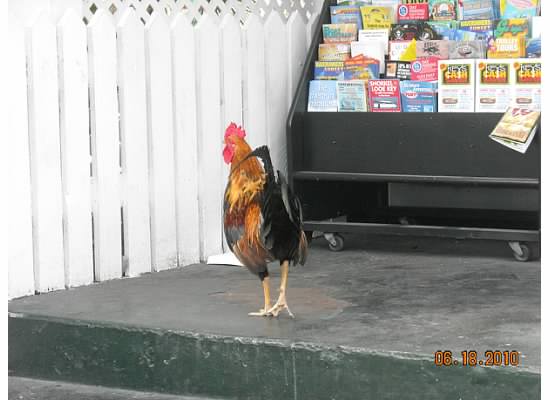
Or maybe it was the Gay Pride parade, or the frosty drinks, or the drag queen show, or the roosters, or even the sunset. Whatever it was, the voices chilled. Day by day, they had a little less to say.


gay pride chickens frosty drinks gay pride parade itty bitty key west sunset


And then, on our third day there, we went on a snorkeling trip. Imagine being piled onto a boat with a group of strangers and the promise of diving in the cool offshore waters and seeing all variety of marine life. Exciting, right? Even better, on the way back to shore the crew would provide all the beer or wine one could drink. Who wouldn’t enjoy this experience?


My voices, that’s who. Yes, what should I wear that would be appropriate to snorkel while hiding the parts of me that needed hiding? How was I going to see the shark that was sure to attack me when I had to take off my glasses to put on a facemask? How could I breathe through a snorkel when my gag reflex kicked in every time I put the snorkel in my mouth? What if I got separated from the group and was left in the ocean? What if  I couldn’t follow the directions on jumping in and everyone laughed at me?  By the time I got to the boat in my carefully picked out bathing suit/shorts combination with strategic coverup, every scenario on how to die or be humiliated snorkeling had been painstakingly considered and accepted. I walked up the plank as if I was, well, walking the plank. And then we were off.


Glancing around the boat, I noticed a couple animatedly chatting in German. He was tall, dark haired, great looking, and, when he removed his t-shirt, I saw he was incredibly well muscled.  She was short and squat. Her hair was cut indifferently and held back with an elastic band. She wore a shapeless white cover up that contrasted nicely with her sunburnt face. Then she pulled off the cover up.


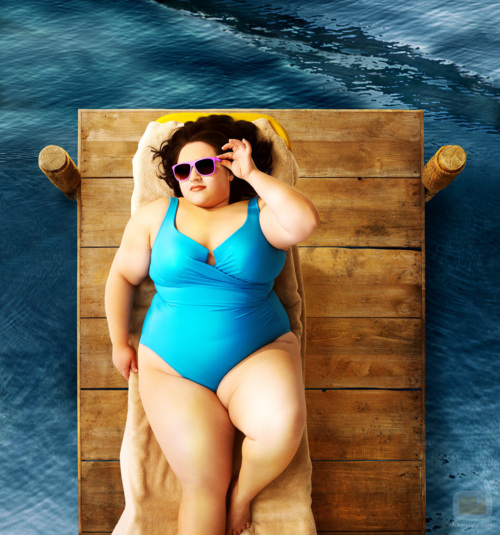
She wore a one piece cut high on the thighs, low on her cleavage. Her skin had the porcelain whiteness of someone that didn’t get a lot of sun exposure. She had fat rolls. Not to be unkind, but to report the facts,  she had back rolls and side rolls and thick, chunky thighs. Thick, chunky, white thighs.


from website c'mon fatso


http://cmonfatso.com/2011/06/22/fat-girl-in-a-swimsuit/


The voices in my head, coming out of their heat and/or alcohol induced torpor, tried to chime in, but for once, I shut them down. And, without the voices giving their opinion, I thought, why the hell not? Why shouldn’t she relax on a boat in her swimsuit when the temperature’s over 95 degrees. Why shouldn’t she be comfortable in her own skin. Why shouldn’t she enjoy a day on the water with a man who obviously adores her.


And with that, the voices in my head disappeared, never to be heard from again. I spent the rest of my time in Key West wearing what I wanted and doing what I wanted. I was finally free. Not only that, but the voices kept gone even after I left Key West and returned home.

I am sure there are all sorts of rational, science based explanations for the transformation I underwent, but I give the credit to Key West. There are sacred places in the world, full of magic and wonder. For me, Key West is one of those places. Some nights I imagine the voices, seven miles off shore under the white sand of the ocean floor, making nasty comments to each other to pass the time while they wait for me to return and retrieve them.

Their wait will be in vain. There’s no room in my head for them any more.


Not Dealing with Dementia


June and Ward Cleaver (Barbara Billingsley and...

June and Ward Cleaver (Barbara Billingsley and Hugh Beaumont). (Photo credit: Wikipedia)

Television moms and dads are kind, generous, clean, independent, and a source of wisdom. Real life moms and dads can be mean, self-centered, critical, and looking for a handout.  Such is the cards some children are dealt.


Dementia

Dementia (Photo credit: Fulla T)

These abusive moms and dads don’t miraculously turn into saints as they age, either. Most of the time the dysfunctional behavior they’ve exhibited worsens, rather than improves, as they age. If they’ve abused drugs, alcohol, or neglected their health, they may get much worse.


What to do when bad mom or bad dad (or both) are no longer functioning well at home alone? I don’t mean the not able to shovel out their driveway or lift the air conditioner out of the window type problems. I mean when they think strangers are coming in through the drainpipes and they think one of the intruders stole their gun. That scary not functioning well may be dementia.


Dementia is a broad term used to describe difficulties in the areas of language, judgment, behavior, thinking, and memory. Some causes of dementia, such as metabolic disorders and tumors, can be reversed. Other causes of dementia, such as Alzheimer’s disease, can only be slowed down, not cured. Repeat, not cured.  Pay careful attention to the part of the happy pharmaceutical commercials that caution,  “All patients will get worse over time, even if they take wondrous dementia drug.”


If you’ve had a great relationship with your parents, filled with mutual respect and assistance, it’s easy to say you’ll do whatever it takes to keep mom and dad safe. Even if it means moving them out of the home they’ve lived in for the last thirty years. Even if it means hiring someone to stay with them so they don’t burn the house down. Even if it means hiding the car or car keys to prevent them from driving to their favorite store that went out of business twenty years ago. Even if it means taking time off from work to accompany them to doctor’s appointments or leaving work early to rush home to deal with emergencies.


But if you haven’t had a great relationship with your parent, maybe haven’t even talked to them in five, ten, fifteen, or twenty plus years, what’s your responsibility when the neighbors start calling with their concerns? Do you forget the past and hope they’ll become nice? Put on your martyr uniform and hope for the best? Make an anonymous call to Elder Services and wash your hands of it?


There is no easy answer to these questions. Letting your conscience be your guide doesn’t mitigate the guilt that comes with the decision to keep your distance from a demented parent. If you decide to re-engage with the parent, there will still be the resentment that comes with putting your own life on hold to care for a parent who never cared for you. It’s an intensely personal decision that each adult child must wrestle with and decide based on all of the myriad considerations and individual details of their life. If you do decide to ride to the rescue, don’t expect the parent to be grateful for your efforts. Age doesn’t make people any less dick-ish, nor does dementia.


As someone who has wrestled with this issue, rest assured I don’t take my abandonment of my parent lightly. There’s a better than average chance that I am the best suited of my siblings for understanding and navigating the complexities of having someone declared incapable of making decisions to pave the way for admission to a nursing home. Not just because I’m a nurse, but also because I’m the oldest. Unfortunately I can’t forget or forgive the toxic parent-child relationship that ultimately ended with my decision to stop speaking to my parent over twenty years ago. I can’t let that go, even though part of me says it’s my duty and part of me feels incredibly guilty that I can’t caretake this person who can no longer caretake themselves.


I won’t deny that seeing my parent in their current state, even from a distance without saying a word or them being aware of my presence, breaks my heart. I wish I could find it within myself to soften, bend, and do what some would insist is the right thing. But I can’t.


And as much as I salute those who can, I acknowledge that there are those of us who can’t. Age and infirmity doesn’t turn a toxic parent into a saint, it only turns them into a old, sick toxic parent. Don’t judge me for turning my back.  It’s like they say when you fly, if the oxygen mask drops down, you have to put it on yourself before you can help someone else. Unfortunately my parent has demonstrated that they would suck up all the oxygen in my world if they could. As bad as I feel about their condition, I won’t let them.

Day 3: flight to Yazd - inflight safety card

Day 3: flight to Yazd – inflight safety card (Photo credit: birdfarm)