Things to Worry About

The other night I lay in bed worrying about all of the out-of-control aspects of my life. My recent move to South Carolina, current unemployment, houseboat in need of repairs, and car problems have pushed my shoulders to a permanent position slightly below my ears and caused the left side of my jaw to clench. As a nurse, I know that stress can cause stomach problems, insomnia, elevated blood pressure, and chest pain. Lately, I’ve had them all.

My daughter restricts me to only worrying about three problems each day, but even the process of choosing three problems to focus on leads to palpitations and emotional paralysis. Is it any wonder I find it hard to sit down and write? Any surprise that after three weeks my clothes remain in a suitcase rather than hung up in my closet? I think not.

I’m embarrassed to admit (but some of you won’t be surprised to hear) that some of my anxiety is irrational. It’s one thing to be stressed about finding a plumber to replace a hot water heater on a houseboat, another to worry that poisonous insects will squirm up through the air conditioning vents and crawl into your ears while you sleep. Right? It’s normal to worry you’ll encounter a loose dog while walking your dogs and have to break up a dog fight, slightly crazy to think a black snake (googling a picture will haunt my dreams so I imagine an eight foot long snake as thick as my arm) will be lying in wait on the side of the road and attack me. My daughter tells me it must be hard to live in a world where I’m always waiting for the worst to happen. It is.

Pharmaceuticals aren’t helping nor is alcohol. I could try meditation, but worry some creature will scurry over me while I’m lying prone. In my mind, my South Carolina lakeside home is as dangerous as the Florida Everglades at night. That sums up my skewed thought processes.

In desperation, I’m trying a new strategy to deal with my stress. Instead of agonizing over it, I write it down on a white board titled “things to worry about.”  My list covers everything from a caterer to fire ants. It’s a grand conglomeration of every single thing I can think to worry about, no matter how insignificant or psycho it seems. It guarantees, unless someone sneaks into my house and erases it, that I don’t have to keep all of my worries at the forefront of my thoughts. Instead they are readily available and easily added on to.
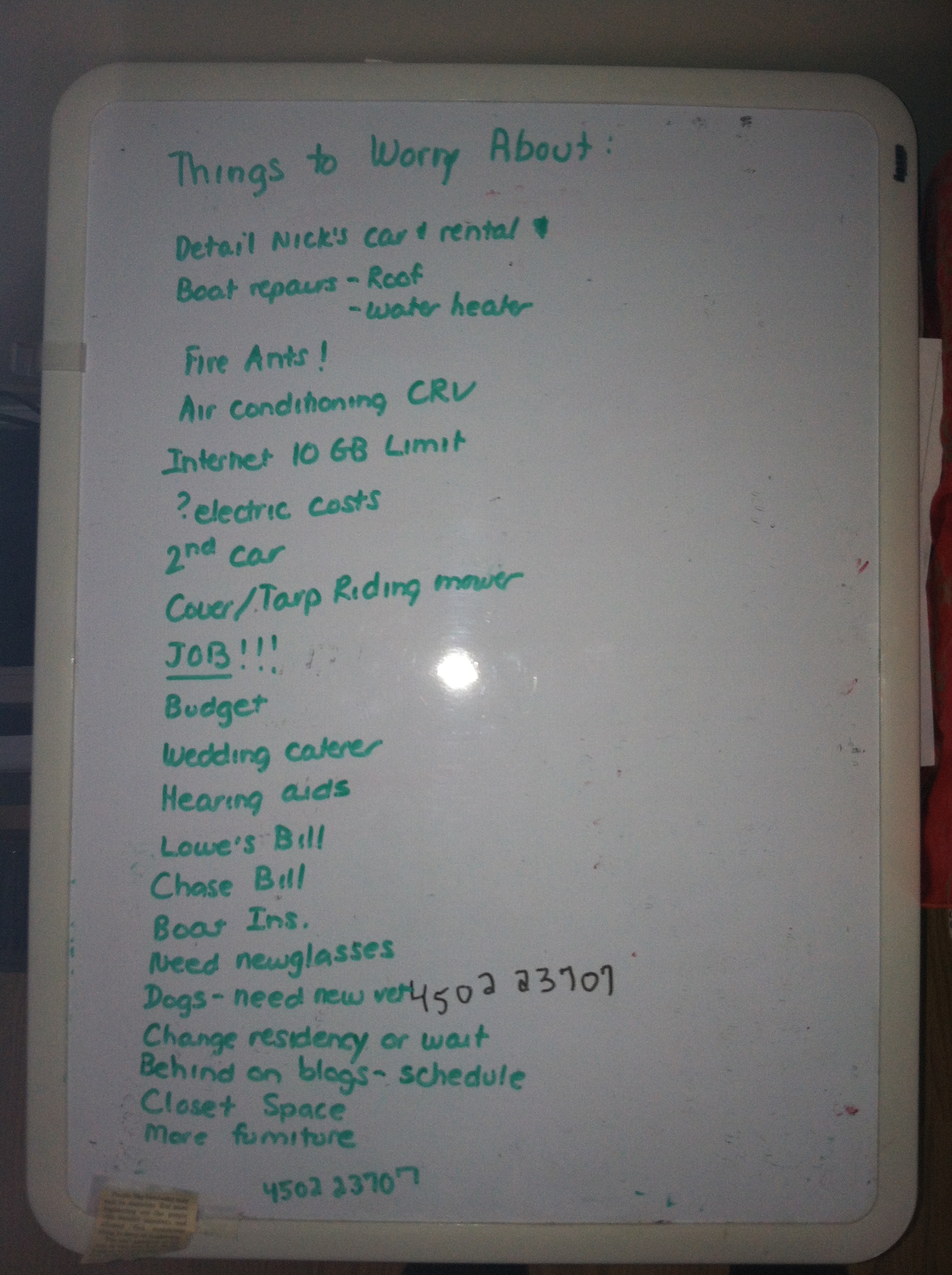
Things to worry about. Must add snakes.

Things to worry about. Must add snakes.

Silly? Perhaps. Effective? Hell, yes. Since I’ve started the list, my muscles have untightened, my sleep improved, and I’ve even managed to pump out a blog post. Now if only I could make money off my brilliant idea…

I Miss My Things

I miss my things.

Missing: My Things

Missing: My Things

It’s been 2 weeks and 2 days since the moving company arrived at my house and ushered all of my most prized personal possessions into their big truck. When they were done, I received a copy of the packing list and they drove off, promising to reunite me and my things within a week.

It didn’t happen.

I’ve called my relocation specialist several times and received vague promises of a delivery soon. “I’ll call you back in a few days to firm it up,” he assures me. But no call comes.

It’s amazing how empty a house is with only two beds, a dining room set, and two folding tables. It echoes.

In Fight Club, Tyler Durden claims “The things you own end up owning you,” and I wish I could be more zen-like and unattached about not having my things, but that would be a lie. I miss my things. My desk, mostly, and my comfortable desk chair. The asthma medication I ran out of several days ago that I can’t refill because there’s a three-month supply on the truck. A cookie sheet. My spice collection. Extra vacuum cleaner bags. The whiteboard for my refrigerator. Even though it seems like a random collection of stuff, it’s the stuff that makes a house a home and grounds me. I need it.

Okay. I don’t need it. I want it.

The things I need are already here. The love of my family. My dogs. Good health. A creative mind. A sense of peace and rightness in my world. The truck didn’t take any of that, I did.

Having a desk to put it on doesn’t seem that big a deal after all.

Sarah Collins, Will You Please Go Home!

I moved into a cul-de-sac recently and discovered that one of my neighbors has no sense of boundaries. Not only does she think the entire cul-de-sac is her property, but everyone finds her wandering ways endearing and sweet. “That’s Sarah Collins,” they say with soft drawls and smiles. “She just does whatever she wants.”

What the blond bitch wants, as far as I can figure out,  is to prowl around my yard, follow me when I take my dogs for a walk, and crap on my lawn.  I’ve always wanted an incontinent stalker.

Sarah Collins stopping by to drop off a little something something.

Sarah Collins stopping by to drop off a little something something.

Now, I’m trying to be a good neighbor. I want to get along.  But can’t I walk out the front door without Sarah Collins strolling by to check on me? And isn’t it enough I have two dogs to clean up after already? Must I add Sarah Collins to the mix? When I walk by her owner’s house,  I notice his lawn is pristine and green. Mine is marked by urine spots. Coincidence? I think not.

I don’t have any options at this point either. Sarah Collins has been ruling the neighborhood for the last ten years. As I speak, she has entered my yard for the tenth time tonight. No longer happy with the view from the ground, she’s walked up the steps to my second story deck and is standing at the gate, waiting to be let in.

I refrain from yelling at her. I want to be neighborly. Still, I previously lived in the land of leash laws and picking up your own dog’s poop. Down here, that’s not the way things work. In fact, my neighbor’s are entertained by the sight of me parading my leashed dogs around the circle,  leaning down occasionally with one baggie covered hand. “Oh, we just leave it,” they say. “It’s what dogs do.”

Perhaps, with time, I will become as mellow as the people I live among. For now, though, I wish Sarah Collins would go home, and stay there.

Ever had a neighbor’s dog drive you insane? How did you deal with it? Suggestions wanted in the comments.

Broken Hearts and Resilience

The recent death of George Jones had me listening to “He Stopped Loving Her Today” and thinking about people who can’t bounce back from a broken heart.  Those unhappy souls who, following the death of a loved one or a failed relationship, turn to unhealthy coping behaviors, such as alcohol or drug abuse and sometimes progress to suicide, intentional or not. “Whiskey Lullaby” by Brad Paisley tells the tale of a spurned lover, “We watched him drink his pain away a little at a time, but he never could get drunk enough to get her off his mind until the night he put that bottle to his head and pulled the trigger and finally drank away her memory.”  Country star Mindy McCready died of a self-inflicted gunshot wound on her front porch a month after the man she called her “soul mate” shot himself on the same porch. Love can kill.

English: Broken heart sewn back together

English: Broken heart sewn back together (Photo credit: Wikipedia). Some broken hearts can’t be fixed.

Most of us who suffer a broken heart go through a period of intense mourning, but few of us plunge into a devastating tailspin from which we can’t recover. Why? In psychological terms, it’s called resilience, and it refers to the quality that allows us to be knocked down by life but return, sometimes even stronger.  Though it’s romantic to think our broken heart is a reason to give up and sink into depression, it’s not a healthy coping response. Believing we can mend and learn from the experience is.

And maybe that’s the difference between those who survive a broken heart and those who don’t. The survivors mourn the loss, remember the good times, and know that at some point there will be better times.

Was Lost, but Now I’m Found

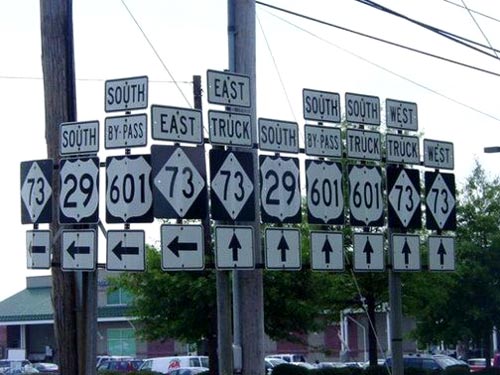
The joke in my family is that if I say take a right, the correct action is go left. Most trips that end in being lost start with my directions. It has always been that way.

traffic-signs-06

My lack of directional skills combined with planning a solo vacation driving to unfamiliar places has been a recent cause of angst. Yes, I could get a GPS. Yes, I could use Mapquest. Deep down I knew no matter what I used, my driving would end with me pulling over to the side of the highway, curling into a fetal position and crying until the Highway Patrol rescued me. Call it fate.

Too ashamed to ask my daughter to call in sick for a week and act as my chauffeur, I downloaded Verizon navigator to my phone, printed out my maps and highlighted them, and headed out, determined to break the curse and not get lost. But, before I even pulled out of the hotel parking lot, I realized my problem. I had too much information and trusted none of it. It was time for a change. I threw my maps in the backseat and put my faith in GPS.

At first, listening to the Verizon navigator confused me. Directions like “turn right in 3.4 miles” and “go straight on highway 123” resulted in me second guessing the voice, turning too early or straining to see road signs. But then, after two very small mistakes trying to out think the system, I decided to listen to the voice and follow its commands.

Amazingly, I made it to all my destinations without getting lost. Once I gave myself over to it, driving became enjoyable. No edge of my seat second guessing. No worry that I’d end up the wrong way on a one way street. As long as I had an address, I could get there.

As I cruised along, content in the knowledge I’d reach my destination, I thought about how many times I’ve overloaded my personal GPS with facts and figures rather than listening to the inner voice trying to guide me on the right path. It’s easy to extinguish our faith in ourselves. It’s easy to second guess.

It’s hard to trust.

But I trusted a satellite navigation system that I couldn’t see, touch, or feel and ended up where I needed to go. Maybe it’s time to trust my personal navigation system to do the same.

The Case of the Dirty Dentist

English: Putting toothpaste on a toothbrush. T...

English: Putting toothpaste on a toothbrush. The toothpaste is Crest Pro-Health Clean Cinnamon, 0.454% stannous fluoride, 0.16% w/v fluoride ion. Deutsch: Zahnpasta auf eine Zahnbürste auftragen. Русский: Выдавливание зубной пасты из тюбика на зубную щётку (Photo credit: Wikipedia)

Most of us wouldn’t think twice before checking that our silverware is clean at a restaurant.  But, when we sit in the dentist’s chair nervously eying the tray of gleaming stainless-steel instruments laid out beside us, we don’t pick them up and make sure they’re clean. We rely on our dental professionals to sterilize anything going into our mouth. That reliance may be a mistake.

Last week the Board of Dentistry performed a surprise inspection of oral surgeon Dr. Scott Harrington‘s Oklahoma office and found numerous problems with sterilization of instruments. The good doctor’s response when questioned?

“Dr. Harrington referred to his staff regarding all sterilization and drug procedures in his office,” the complaint read. “He advised, ‘They take care of that. I don’t.'” His attitude seems to be that not infecting his patients with blood-borne diseases is someone else’s job.

Other issues that came to light during the inspection included the doctors reuse of needles, disregard of expiration dates (one bottle of morphine expired in 1993) and his use of unlicensed assistants to perform tasks only a licensed dentist should perform, such as giving IV sedation.

Now over 7000 patients will undergo  testing to see if they contracted hepatitis or HIV due to the oral surgeon’s noncompliance with basic infection control practices.  In the meantime, don’t be fooled into thinking this is an isolated problem caused by one errant doctor.  On March 22, 2013 the Rhode Island Board of Dentistry temporarily shut a practice down after finding debris on multiple instruments in ‘sterile’ packages in exam rooms. No word on whether that dentist took responsibility for his office practice.

But, speaking of responsibility, how much responsibility do patients have to protect themselves from healthcare acquired infections? People have been trained not to touch someone else’s blood unless they wear gloves. People are encouraged to use barrier devices, such as condoms, during sex to prevent STD’s. Should our public health officials start a campaign to encourage patients to protect themselves during invasive procedures such as dental procedures, colonoscopies, and injections? If so, how can that be accomplished?

Recent articles have suggested patients ask dentists to prove they’re following guidelines in the care and maintenance of sterilization machines.  They’ve also advised patients to request to inspect the instruments prior to being removed from their sterile packages.  Other tips are to watch the dentist’s glove use, look at the overall office cleanliness, and quiz the dentist and staff as to how they handle reusable instruments. All excellent points, but it also requires a level of doctor-patient transparency and discussion that’s not usually seen. More importantly, how is your dentist going to react to his judgement and cleanliness being questioned?

In my work in the healthcare field, even the idea of a patient (or another healthcare team member) questioning whether someone has washed their hands before patient contact is a source of controversy. In a Swiss study, 76% of patients felt uncomfortable asking a nurse if she’d washed her hands and 77% felt uncomfortable asking a physician the same question. If patients don’t feel comfortable asking a simple question like that, do we really expect them to ask complicated, technical questions about sterilization procedures? Asking for clean instruments should be as easy as asking for a new knife or fork at a restaurant when the one on the table is dirty, but it isn’t.

English: South China Sea (May 16, 2006) - Hosp...

English: South China Sea (May 16, 2006) – Hospital Corpsman Steffon Corna sets up dental tools for a tooth extraction in the Dental Department aboard the Nimitz-class aircraft carrier USS Abraham Lincoln (CVN 72). Lincoln and embarked Carrier Air Wing Two (CVW-2) are currently underway in the Western Pacific operating area. U.S. Navy photo by Photographer’s Mate Airman Apprentice Brandon C. Wilson (RELEASED) (Photo credit: Wikipedia)

Will I stop going to my dentist? No. Will I ask to inspect the instruments for debris before my next procedure or cleaning. Yes. Hopefully he’ll understand, but if he doesn’t, I’ll tell him I’m holding him to the same standards I’d hold a restaurant to. I’m sure he doesn’t like eating off dirty forks any more than I do.